
Blake Emal recently posted a list on X I'd happily staple to every content request: twelve things to give a startup marketing team before asking it for more content. Number one is a description of the offer, in words someone outside the company understands. Number two is the questions customers actually ask, saved in their own wording.
Notice what's missing from the top of that list: topics, keywords, a posting schedule. The first things a writer needs have nothing to do with writing. They're about the customer and the offer, and they usually live in someone's head, a sales call recording or a support inbox, nowhere the writer can reach.
So when the request is "we need more content," I'd answer with a question: more of what, for whom, saying what? Below is the brief that answers it. It fits on one page, and once it exists, every piece of content gets better and faster to write.
01Generic content is what happens when the writer has to guess
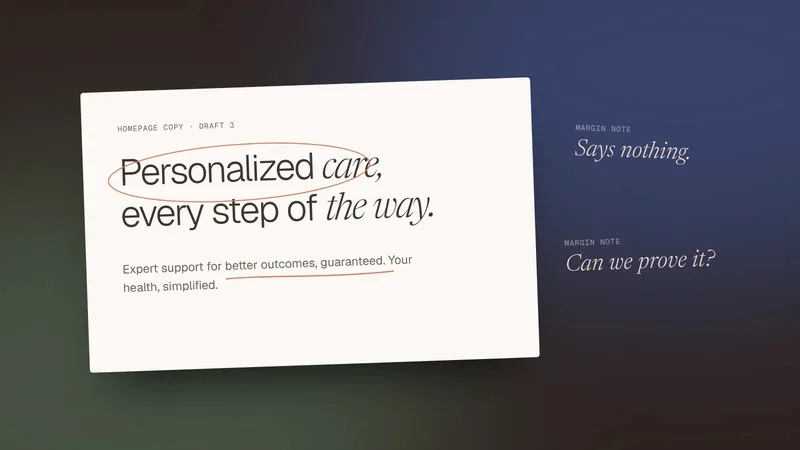
Give a good writer a topic and nothing else, and they'll do what anyone would: research what's already been published, then write a cleaner version of it. The result is competent, well structured, and interchangeable with what your competitors posted last month. Ask an AI tool for the same thing and you get the average of the internet, delivered faster.
The things that make content specific can't be researched from outside. Which question your buyers ask on the second sales call. The phrase they use for the problem, which is rarely the phrase on your homepage. The reason the last three deals stalled. The opinion your founder holds that most of the market would push back on. Those live inside the company, and if nobody hands them over, they don't make it into the writing.
Creative directors have been saying this about ad briefs for decades. John Kovacevich wrote on Medium that agencies shouldn't start work until the brief is right, and he quotes the classic bad one: "We're looking for ideas to improve brand perception." His fix applies to content too: be precise about the goal and the constraints, and leave the solution open. In his words, "Constraints are good. Guardrails focus creative thinking."
02The one-page brief
Eight sections, one page. Copy it, fill it in once, and update it every quarter. The first three do most of the work, so if you only have an hour, start there.
A few notes on the parts people tend to skip.
Section 3 is the one that changes everything. Your customers rarely describe their problem the way your website does. Their wording is what makes a reader think "that's exactly my situation," and it's the one ingredient a writer can't invent. Copy it exactly, typos and all.
Section 6 is what makes it yours. Content without an opinion can explain things well enough, but it never takes a position, and positions are what people remember and pass on. One honest belief is enough to start.
Section 8 changes for every piece. The rest of the brief stays stable for months. This part gets written fresh for each article, email or post, in two or three lines.
03Where to find each piece in one afternoon
All of this already exists somewhere in the company. Someone just has to go and collect it.
Customer questions (section 3): the support inbox and the sales calls. Open the last twenty support tickets and, if you record calls, two or three recent sales conversations. Copy every question as written. You'll see the same five or six come back, and those are your first articles.
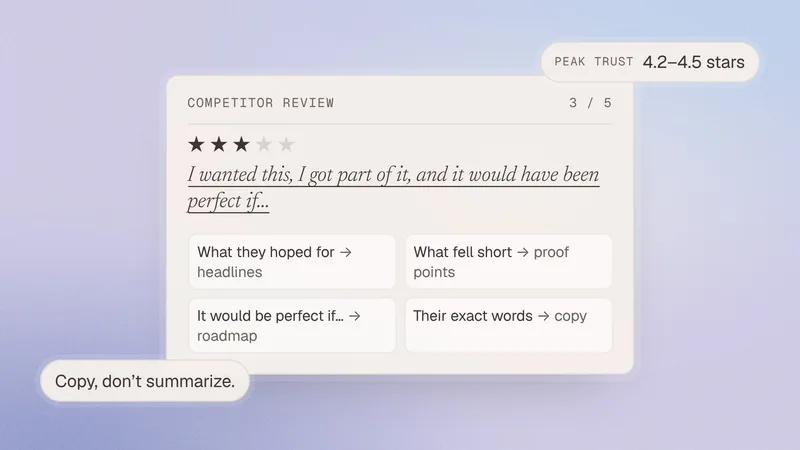
Customer phrases (section 3): reviews, yours and your competitors'. Joanna Wiebe of Copyhackers has taught this for years as review mining: skim reviews for about twenty minutes, focus on the two- to four-star ones because they're the most candid, and clip any "language that stops you." Your competitors' reviews count too. They tell you what buyers in your category wanted and didn't get.
Objections (section 4): the deals you lost. Ask whoever does sales for the real reason behind the last five "no"s or "not now"s. If that's you, scroll back through the emails. The polite version ("budget") is often hiding a more useful one ("we weren't sure it would work for a team our size").
Proof (section 5): the boring folder. Case study drafts, the numbers in last quarter's board update, testimonials that came in by email and never got asked for permission. Ask now, it takes one message each.
Opinion (section 6): fifteen minutes with the founder. Record a voice memo answering one question: what does most of our market get wrong? Transcribe it. The best line often comes in the first two minutes, said half as a joke.
04Attach it to every request
Once the brief exists, every content request changes shape. It becomes the brief plus three lines for section 8: who this piece is for, what they should do after reading, and how you'll know it worked.
Two habits keep it useful:
- Update it every quarter. New questions show up in support, a competitor changes its pitch, a proof point gets permission. Fifteen minutes is enough.
- Watch the writer's first question. If they still need to ask "who's this for?" or "what do customers call this?", the brief has a gap. Fill it in the brief, not in a Slack thread, so the next person doesn't have to ask.
Given a page like this, a good writer stops guessing and starts choosing: which question to answer, which objection to take on, which customer phrase to put in the headline. That's when content starts sounding like your company and nobody else's.
Then ask for more content. You'll probably need less of it.